
A closer partnership between a university and a science and technology association opens broader opportunities for developing innovative talent.
On April 30, EIT and the Zhejiang Association for Science and Technology signed a comprehensive strategic cooperation agreement at EIT. They will collaborate extensively in developing leading scientific journals, hosting high-level academic exchanges, building science outreach facilities and nurturing scientific and technological innovators.
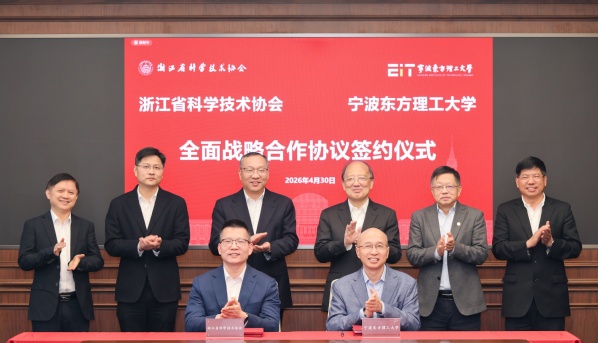
The ceremony was attended by EIT President Shiyi Chen, a member of the Chinese Academy of Sciences; Min Shen, Secretary of the association's Party Leadership Group and Vice President; EIT Executive Vice President and Provost Dongxiao Zhang, a member of the US National Academy of Engineering; and Vice President Chunmiao Zheng. Representatives of the provincial and municipal associations, Zhenhai District and relevant EIT offices also attended.
Wenjun Zeng, EIT Vice President, President of its Association for Science and Technology and a foreign fellow of the Canadian Academy of Engineering, signed with Weiwei Sun, a member of the provincial association's Party Leadership Group and Vice President.
Shen described the association as a bridge connecting the Party and government with scientists and engineers, and universities as a source of basic research and outstanding talent. Their collaboration is timely and significant. He praised EIT's role in Zhejiang's science and technology landscape and its achievements in attracting high-level talent, producing important research and supporting regional innovation.
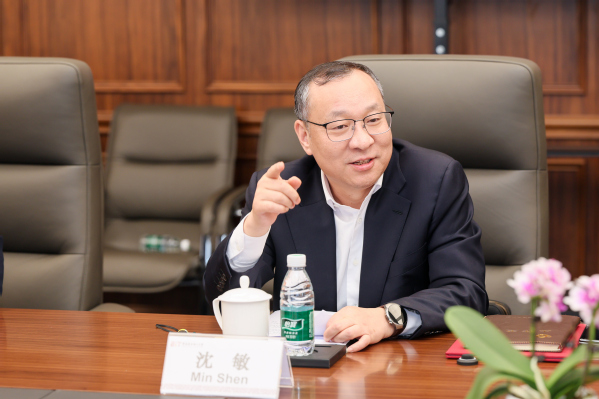
The partnership combines a science and technology organization with a high-level research university and explores the integrated development of education, science, technology and talent. By combining the association's platforms with EIT's innovation strengths, the partners aim to set an example for comprehensive cooperation and the development of university science associations, supporting Zhejiang's high-quality development and demonstration zone for common prosperity.
Chen said EIT's commitment to a high starting point, compact scale and excellence, innovation, and international engagement guides its work in strategic fields including AI, integrated circuits and intelligent manufacturing. Through interdisciplinary collaboration, it is developing a research ecosystem centered on innovation and advancing frontier technologies and their applications.
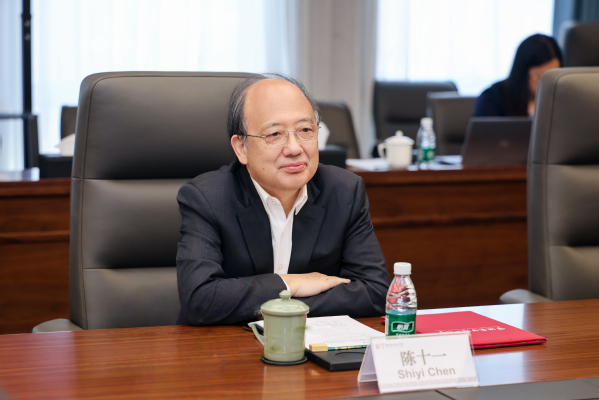
The provincial association has a province-wide network of academic societies, prominent academic programs and extensive capacity for science outreach. Cooperation will focus on four priorities: leading journals, academic exchange, science outreach facilities and talent development. The partners will explore a demonstrative model of collaborative innovation, accelerate the application of research results and help EIT become a cradle for scientists with entrepreneurial spirit and entrepreneurs with scientific understanding, contributing to national scientific and technological self-reliance.
Under the agreement, they will jointly publish high-quality English-language scientific journals benchmarked against leading international standards; organize high-level international academic events through platforms such as the World Young Scientist Summit; develop science education facilities to improve public scientific literacy; and build opportunities to attract and nurture leading researchers and young talent, enabling young faculty and scientists to thrive.
After the signing, Shen's delegation visited EIT's Youngor Library.