
On July 13, Zongwei Cai, Associate Vice President of EIT, member of Academia Europaea and Head of the Division of Science, led a group of researchers to the Xingning campus of Ningbo Medical Center Lihuili Hospital for a high-level interdisciplinary symposium.
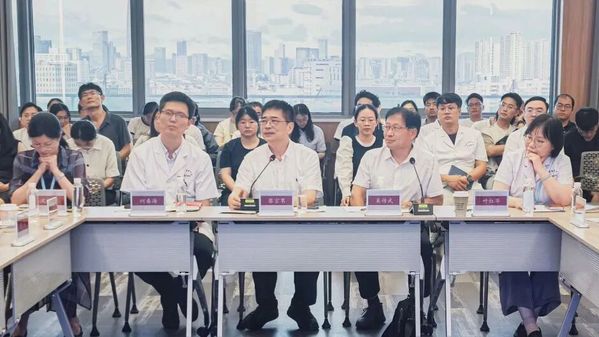
Through research presentations and in-depth discussion, the symposium focused on mass spectrometry imaging and metabolomics, organ-on-chip systems, biomedical engineering, nanomaterials and drug delivery, environmental health, and precision diagnosis and treatment. It aimed to advance substantive collaboration in basic research and clinical translation.
Chuanwu Xi, Assistant to the President and Director of the Office of Global Engagement; Chunhai Ke, Party Secretary of Lihuili Hospital; and Honghua Ye, Hospital President and Deputy Party Secretary, attended. Vice President Zhouji Shen chaired the meeting.
Seventeen EIT researchers, including Tian Xia, Jianbo Gao, Chen Zhu and Shihui Wen, presented their research directions and latest progress. Their detailed presentations demonstrated both strong technical foundations and a clear focus on clinical translation.
Cai's team demonstrated a combined mass spectrometry imaging and spatial multi-omics platform for precise visualization of metabolite and protein distributions in clinical research. Xi's team introduced medical-device infection control and the environmental transmission and control of infectious diseases. Dayong Jin's team discussed organelle-targeted precision diagnosis and treatment using upconversion nanoprobes for dynamic monitoring of mitochondria. Hang Zhang's team presented progress in hydrogel materials for tissue repair. Gao's team described continued improvements in rapid detection of urinary biomarkers and high-throughput ultrasensitive protein assays. Zhu's team showed how an automated sample-preparation platform significantly improves analytical efficiency.
Other researchers, including Shihui Wen, Hao Zhang, Shan Zhou, Yuanlong Huang, Fabai Wu, Yanji Wei and Yuqing Ye, presented developments in luminescent nanoprobes, spatial transcriptomics optimization, clinical metabolomics cohorts, indoor-air exposure mechanisms, atmospheric interfaces, environmental viromics, cardiovascular hemodynamic modeling and targeted microsphere delivery.
Clinical presentations involved leaders from thoracic surgery, the neuroscience center, sports medicine, intensive care, nephrology and the institute for medical–engineering innovation. Nearly ten clinicians and researchers, including Guodong Xu, Jinxian He, Wu Zheng and Yang Zhou, identified urgent clinical problems and proposed concrete opportunities for interdisciplinary work with EIT teams.
The symposium followed the June inauguration of a jointly established academician workstation on environmental and metabolic regulation and major diseases. It provided another opportunity to turn medical–engineering collaboration into practical action.
The meeting showcased EIT's capabilities across disciplinary frontiers and connected basic research with clinical needs. Researchers and clinicians agreed on next steps including joint tissue-sample analysis, validation of additional detection targets and sharing of sample-preparation platforms. Their complementary strengths across basic research, technology translation and clinical validation provide a strong basis for further collaborative work.