
As the tides of the Yongjiang River met the final heat of August and lights along the waterfront shone like a galaxy, nine resonant chimes opened EIT's family reunion on the evening of August 30.
Guests included Yang Yong, Member of the Standing Committee of the CPC Ningbo Municipal Committee and Secretary of the CPC Yinzhou District Committee; Ningbo Vice Mayor Huang Jiong; Board Chairman Yu Renrong; donors; representatives of other universities and high schools from Zhejiang and beyond; 130 new EIT undergraduates; more than 200 doctoral students; and the university's leadership, faculty, staff and current students.
A thousand people gathered to witness both the opening of a ceremony and a generation's declaration of purpose for the AI era.
Pioneering Educational Change in the AI Era
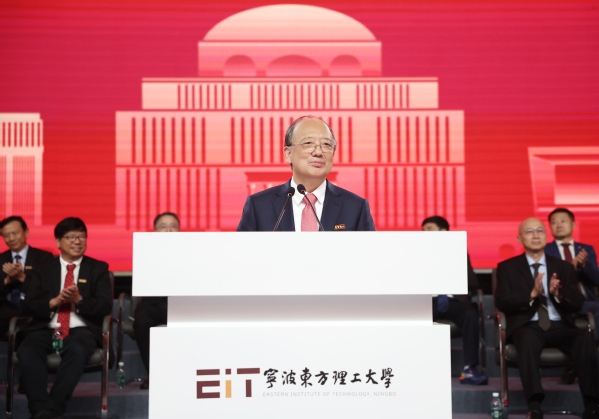
“Welcome to our most important family gathering of the year!” EIT President Shiyi Chen, a member of the Chinese Academy of Sciences, set a warm tone from the outset.
When AI can retrieve vast amounts of knowledge instantly and technology has removed the barriers around it, what is a university's core value?
DeepSeek transformed the global AI landscape overnight. “A new university created for its times can stand at the forefront of global higher education. EIT aims to become an influential university and a leader in innovation and change,” Chen said.
“In the AI era, anything is possible!”
“I believe that among you are future leaders who will change the world and shape your times,” he told the students.
The ceremony was chaired by Executive Vice President and Provost Dongxiao Zhang, a member of the US National Academy of Engineering.
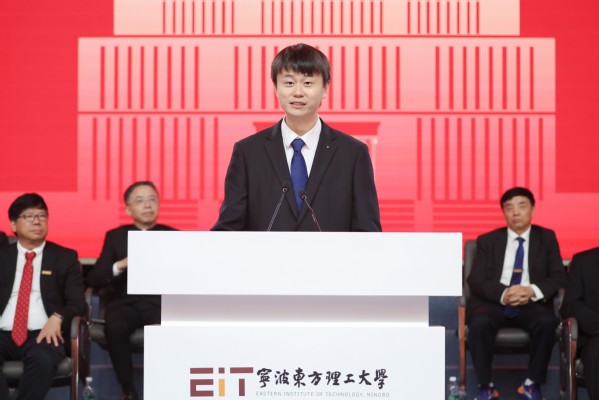
Meanwhile, on the fourth floor of the Chemistry Building beside the Yongjiang River, a robot continued working in Associate Professor Chen Zhu's laboratory in the Division of Science. It needed neither rest nor sleep and learned from every round of experimentation. Its work reflects Zhu's research in AI-driven chemistry, often called AI for Science.
“In our field, we talk about a dry–wet loop. ‘Dry’ means models, code and data on computers, where iteration is extremely fast. ‘Wet’ means the bottles and vessels in the laboratory, where work is slow and often fails,” Zhu told the new students. “During your four university years, build a loop like this for yourselves.”
In Zhu's “AI for Chemistry” course, students use AI to explore the unknown. The “EI Kick” robotics team, comprising ten first-year students, used AI for literature searches and coding. From EIT's laboratories, it advanced to the Capital International Convention Center and finished among the top six nationally as the competition's only all-first-year team.
Rongpeng Cui, a doctoral student jointly trained by Shanghai Jiao Tong University and EIT, moved from undergraduate naval architecture into interdisciplinary research on robot dynamics algorithms and motion-control training. Recently, at the World Humanoid Robot Games, he operated the Tiangong–Jingfeng robot, which ran 100 meters in 9.34 seconds, faster than Usain Bolt's human record and extending the limits of bipedal robot speed.
“Algorithms can simulate countless options, but the courage to attempt the hardest one still comes from inner curiosity and determination,” Chen said.
“A hundred years ago, Hu Shi said: make bold hypotheses and verify them carefully. In the AI era, I would add: if an experiment fails, turn it into data,” Zhu said.
Co-op Education Brings Students into Industry
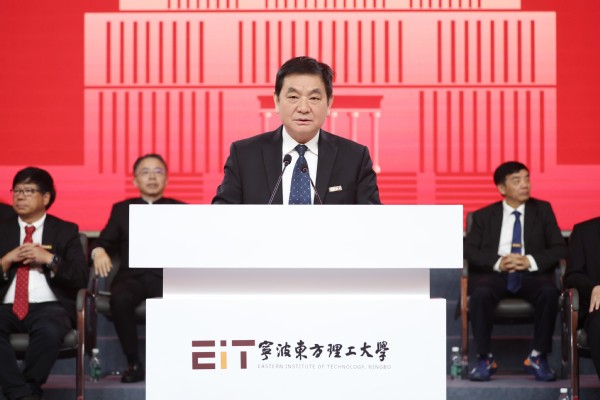
“You are among EIT's founding generations of alumni. You will grow with the university and become a lasting part of its history,” said Board member and Yangtze Memory Technologies Chairman Chen Nanxiang. As a member of the first university cohort admitted after the national entrance examination resumed in 1977, he understood the significance of being a pioneer.
Today, China and the most technologically advanced Western countries stand at the same starting line of the intelligent revolution. Chen described a new model of university–industry education: Yangtze Memory Technologies and EIT have established a dedicated YMTC class, foundation and excellence scholarships, and an innovation fund. He hoped that, twenty years from now, EIT graduates would be among the company's most accomplished professionals.
Industry–education integration runs through students' daily learning. EIT's summer Co-op program brings undergraduates into companies for practical training. This June, its inaugural undergraduate cohort joined 33 companies, including Geely Auto and Bull Group, gaining experience in intelligent manufacturing and AI-enabled industry.
The university's own innovation ecosystem is also growing. Faculty members have founded 21 companies, and 9.1% of its papers are co-authored with industry.
Earlier this year, EIT's principal donor and Will Semiconductor Chairman Yu Renrong told university leaders and faculty representatives that a rapidly changing world demands engagement in the most advanced fields, recruitment of the best talent, and disciplines that are either the world's best or unique worldwide.
Wang Jianfeng of Joyson Group donated to name Joyson Building, while Chen Ruiwu of Hengrun Tongda donated to name Chen Ruiwu Building. Led by Yu Renrong and supported by entrepreneurs and the wider community, successive donations are helping EIT build a world-class new research university.
“The more AI can do, the more precious our uniquely human value becomes.”
“AI can calculate a building's construction costs, but it cannot see the entrepreneurs' devotion to their country,” Chen said.
Choosing an Open Field of Possibility
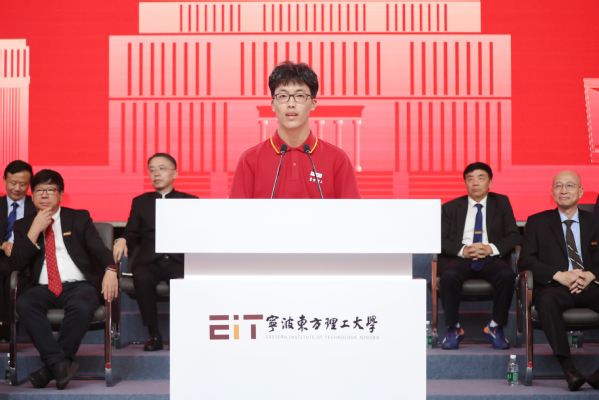
At a university admissions consultation after examination results were released, Zhenhai High School student Chenlin Shen was carrying brochures from several universities when classmates began gathering near the entrance. Curious, he joined them and saw EIT President Shiyi Chen speaking with Zhenhai High School Principal Guoping Wu. Before he had time to react, his class teacher gently nudged him forward. He shook hands with Chen and added him on WeChat.
That afternoon, Shen visited EIT for the first time. He subsequently made it his only university choice. With an entrance-examination score of 688, he chose to “follow my own path and do interesting things.” EIT's admission threshold through parallel applications this year was 662.
This year, EIT gained approval for high-level Trinity comprehensive admissions. It now admits students through both the first-stage general-category parallel application route and the Trinity scheme.
The university has recruited 120 full-time teaching and research faculty members serving as independent principal investigators, including 16 academicians and 75 nationally recognized talents. Ninety-four percent of its PIs have overseas experience. All new undergraduates initially enroll in Computer Science and Technology and may choose their major in the second year. A three-mentor system supports personalized education.
Speaking as the undergraduate representative of the class of 2026, Shen said: “At eighteen, I do not yet have a settled choice of major. So why not change my perspective? Instead of choosing one narrow path, I can choose an open field in which to explore and learn from mistakes.”
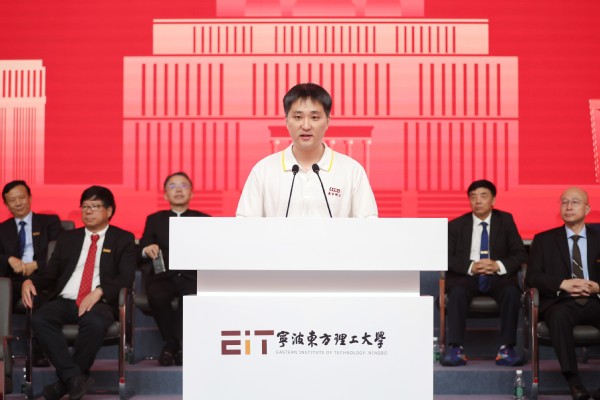
Exploring unfamiliar territory requires exceptional courage.
Yifan Shi, a doctoral student jointly trained by Shanghai Jiao Tong University and EIT, shared Assistant Professor Yuntian Chen's classification of research: “yesterday's research” adds small refinements to established fields; “today's research” follows the crowd in popular areas; and the most valuable, “tomorrow's research,” opens new ground where few have ventured.
Shi once emailed Chen and unexpectedly received a long voice call in response. “Shanghai Jiao Tong taught me the patience to work through derivations. EIT taught me to tackle problems that have not even been clearly defined. Together, these qualities capture what doctoral training means to me: the perseverance to work through difficult problems and the courage to open paths into the unknown,” he recalled.
With support from the Ministry of Education, EIT began admitting jointly trained doctoral students in 2022. Seventeen have now graduated. They have joined institutions including Shanghai AI Laboratory, the Institute of Automation of the Chinese Academy of Sciences and Tencent, or undertaken postdoctoral research at Rice University, the University of Hong Kong, the Hong Kong University of Science and Technology, the Hong Kong Polytechnic University and the Academy of Mathematics and Systems Science of the Chinese Academy of Sciences.
Realizing Dreams and Changing the World
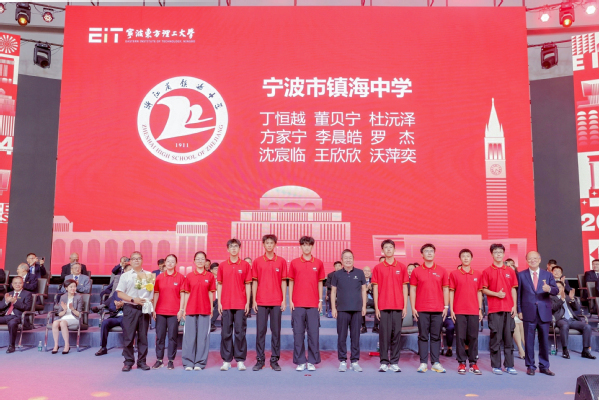
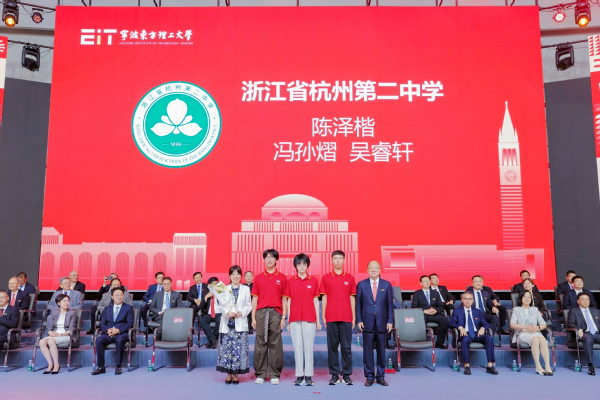
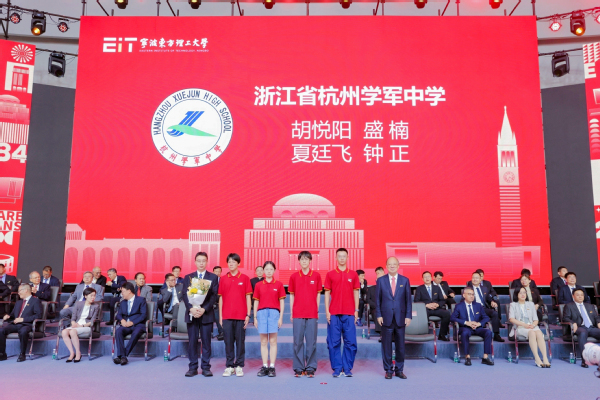
Among the ceremony's most distinctive guests were the principals and teachers of the 130 new undergraduates, who traveled from 58 high schools to witness this milestone. During the welcome ritual, students presented flowers to the teachers who had accompanied them and shook hands with President Chen in gratitude.
The mutual trust and support between high schools and universities in preparing students for the AI era inspired everyone present.
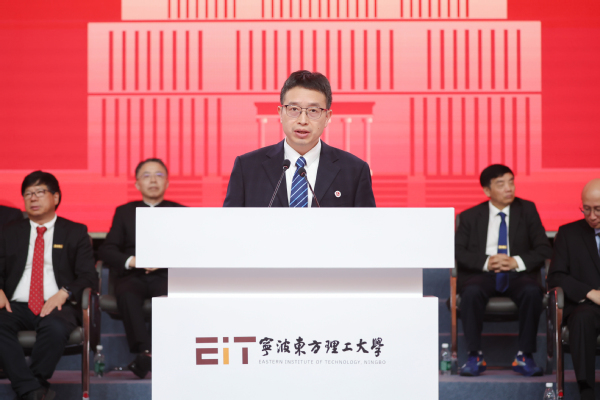
“May your efforts light the road ahead. Ask a truly good question, dare to ask why, and take a path no one has taken.”
“May you be pioneers. The ground you cross becomes a path, and what you build becomes the university's history.”
“May your youth resonate with your times. Place your passions and efforts within the wider world, and let your contribution give your lives lasting meaning.”
Hangzhou Xuejun High School Principal Rungen Fang offered these three hopes and encouraged students to “give the best of your youth to a flourishing country.”
Chen also offered three hopes: build strong foundations and learn together; remain curious and challenge limits; and aim high while caring about the wider world.
“Human curiosity, imagination and values can never be replaced by AI. I hope you will identify problems, create a better world and guide AI toward good, serving national development and social progress,” he said.
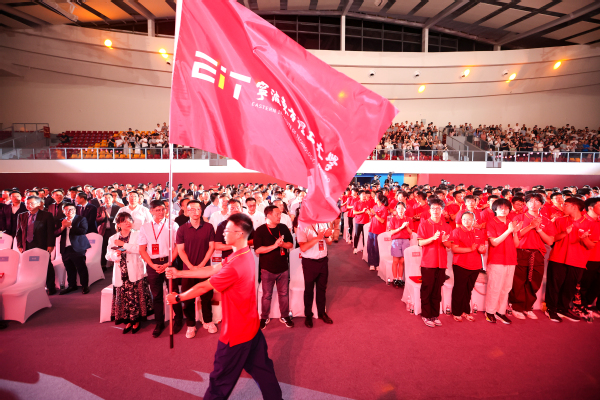
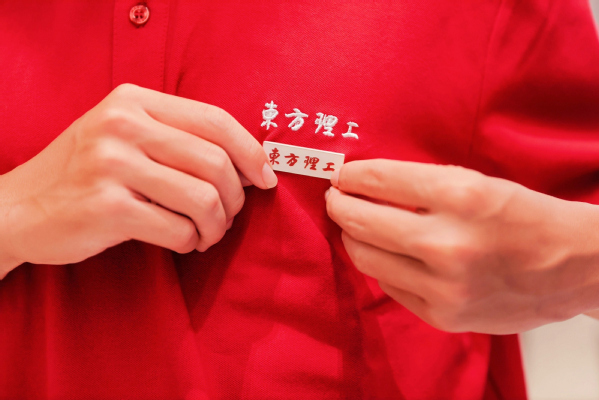
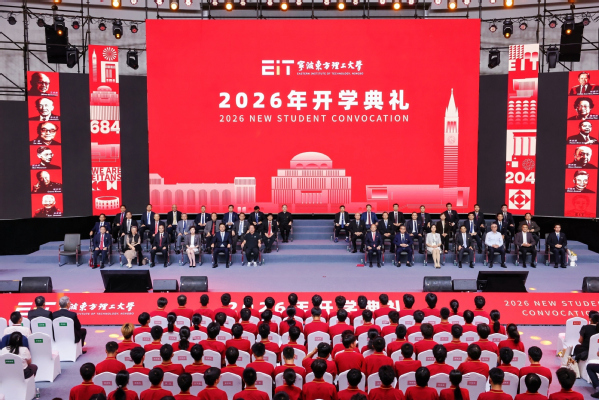
From embarking on university life beside the Yongjiang River to finding courage in unexplored territory, EIT was born for its times and its students have come for the future.
We will expand the possibilities of the AI era!
We will remain committed to country and society!
We will carry forward the courage to open new paths!
A young university, young students and a young community now share the same starting line, moving at full speed toward unlimited possibilities.