
As summer drew to a close, a breeze stirred along the Yong River, accompanied by a lively exchange of ideas.
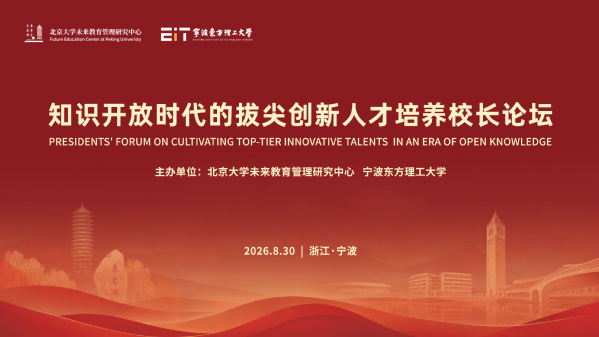
On August 30, Eastern Institute of Technology, Ningbo (EIT) hosted a major gathering of educators. Jointly organized by Peking University's Center for Future Education Management and EIT, the Presidents and Principals Forum focused on educating outstanding innovators in an age of open knowledge.
More than 80 university and secondary school leaders, education experts and scholars attended, representing 10 universities and nearly 40 high schools from Zhejiang and other provinces. Seated in mixed groups, university presidents and high school principals crossed institutional boundaries to bring their educational perspectives together.
The forum addressed both new ideas and practical implementation. It sought to build a bridge between universities and high schools and explore a fundamental question facing all educators: when knowledge is readily accessible and AI is reshaping the future, what kinds of people should education develop, and how?
Questions for Education in an Age of Open Knowledge
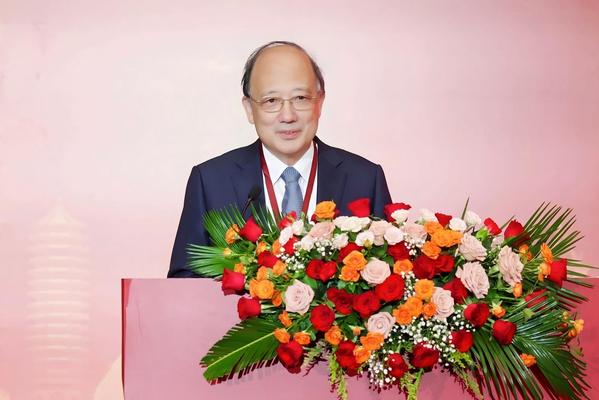
“We live in an era of unprecedented change in how knowledge is acquired and disseminated,” said EIT President Shiyi Chen, a member of the Chinese Academy of Sciences, in his opening address. “How an educational model born in the industrial age should respond to technological change and contemporary needs is a question universities and high schools must answer.”
As a new research university admitted to Zhejiang's high-level Trinity comprehensive admissions scheme just one year after receiving approval for its establishment, EIT itself represents a response to these questions. Its exploration of an integrated “1+3” undergraduate education model, first-year laboratory experience and paid industry placements for all undergraduates has highlighted the need to move beyond selection primarily by examination scores toward recognizing curiosity, a willingness to tackle challenges and the potential to innovate.
“We hope to build close connections between high schools and universities and work together to answer these fundamental educational questions.”
A university draws nourishment from its city. Xiaodong Li, Secretary of the CPC Committee and Director of the Ningbo Municipal Education Bureau, noted that Ningbo is both a birthplace of many academicians and a major manufacturing center. The city is at a critical stage of industrial transformation and development. Educating outstanding innovators requires a coordinated system spanning primary, secondary and higher education; no single city or institution can accomplish it alone. He hoped the forum would draw on expertise from across China, remove barriers between educational stages and develop approaches aligned with national strategies and local industry.
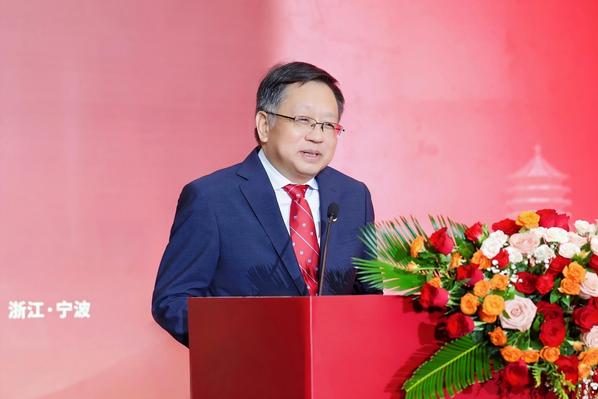
The forum was chaired by EIT Executive Vice President and Provost Dongxiao Zhang, a member of the US National Academy of Engineering.
Rethinking Education in the AI Era
Six keynote speakers from higher and school education examined the foundations of education, the uncertainties of the AI era and collaboration between universities and secondary schools.
What is the essence of education in the face of AI? Jianhua Lin, Director of Peking University's Center for Future Education Management and former President of Peking University, explored this philosophical question in his keynote, “The Intrinsic Nature of Education.”
He argued that educating outstanding innovators requires a return to first principles and a renewed understanding of education's intrinsic nature.
In an age of open knowledge, he called for opening boundaries between disciplines, learning environments and institutions: “Learning is transformation rather than accumulation. Knowledge becomes truly yours only when it changes how you see the world.”
Houqing Yin, Vice President of the Chinese Society of Education, focused on change in school education. He emphasized that high school education is about developing the whole person, rather than simply imparting knowledge. Schools must actively adapt to the intelligent age, move beyond one-way instruction and guide students from superficial information transfer using intelligent tools toward deep understanding and construction of knowledge. Strong disciplinary foundations should support lifelong development.
Shijun Tong, Chancellor of NYU Shanghai, offered a philosophical inquiry entitled “Cultivating the Virtue of Learning in the AI Era.” Human learning, he said, concerns not only what people do and possess, but also who they are.
“As machines increasingly think on our behalf, our greatest concern should be whether people may ultimately lose their sense of who they are.” Tong argued that outstanding talent must combine curiosity with responsibility and make a commitment to learning central to personal development.
Hongwei Fang, Vice President and Provost of Southern University of Science and Technology, shared practical experience in challenging established approaches. From its pioneering “631” comprehensive admissions model and complementary residential college and academic school systems to a semiconductor industry–education base located beside leading enterprises, the university connects education with industry so students grow through addressing real national strategic needs.
Jie Yin, Executive Vice President and Provost of ShanghaiTech University, described its systematic response to AI. With knowledge increasingly easy to acquire and routine skills subject to replacement, ShanghaiTech is advancing an AI innovation initiative, an AI for Science minor open to all undergraduates and practical training in large language models. Yin stressed that general education, rigorous foundations in mathematics and science, and a grounding in the humanities are indispensable for outstanding innovators.
Rungen Fang, Principal of Hangzhou Xuejun High School, drew on frontline teaching experience. Innovative talent, he argued, grows in fertile educational conditions rather than emerging simply from competition to recruit the highest-scoring students. In the AI era, education must protect students' ability to ask questions, aesthetic judgment, and physical and mental well-being.
Roundtables on Education and Collaboration in the AI Era
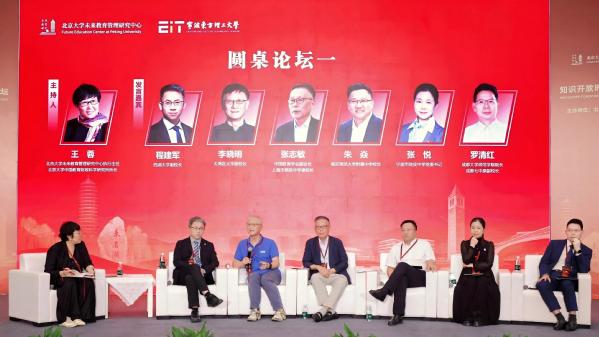
The two subsequent roundtables were chaired by Rong Wang, Executive Director of Peking University's Center for Future Education Management, and Wei Zhao, Provost of Shenzhen University of Advanced Technology.
Participants included Zhimin Zhang, Vice President of the Chinese Society of Education and former Principal of Shanghai Gezhi High School; Jianjun Cheng, Vice President of Westlake University; Fuli Zhang, Executive Vice President of Fuyao University of Science and Technology; Xiaoming Li, Vice President of Great Bay University; Qinghong Luo, Dean of the Teachers College at Chengdu University and former Vice Principal of Chengdu No. 7 High School; Shiming He, Party Secretary of Shenzhen Foreign Languages School Group; Yan Zhu, Principal of the High School Affiliated to Nanjing Normal University; Zheng Zhu, Principal of Nanjing Zhonghua High School; Lei Qin, Vice Principal of the Affiliated High School of Peking University; Yue Zhang, Party Secretary of Ningbo Xiaoshi High School; and Huyue Shen, Executive Vice Principal of Ningbo Zhenhai High School.
Together they explored educational principles and collaboration in the AI era.
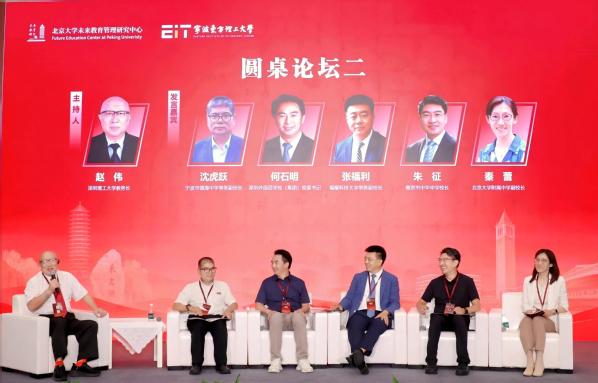
Participants agreed that education should embrace technology while remaining faithful to its purpose and protecting the conditions in which innovators thrive. AI may readily replace mechanical, explicit skills and superficial information transfer, but it cannot replace the tacit human intelligence involved in identifying problems. University–school collaboration should therefore reduce one-way instruction, increase inquiry through projects in real settings and give students time to think, experiment and learn from mistakes. Crossing educational boundaries and nurturing young people's curiosity and vitality will allow innovative talent to develop naturally and healthily.
After more than four hours of discussion, a shared understanding emerged: educating outstanding innovators requires a two-way partnership and a continuous relay between schools and universities.
As access to knowledge becomes easier and AI prompts humanity to reconsider its value, education remains a matter of lighting a fire rather than filling a vessel.
As a new research university and an emerging force in China's higher education reform, EIT is committed to advancing this change.
Beginning on the banks of the Yong River, this joint exploration is only just under way. Amid the expansion of open knowledge, a new approach to nurturing China's own outstanding innovators is taking shape.