
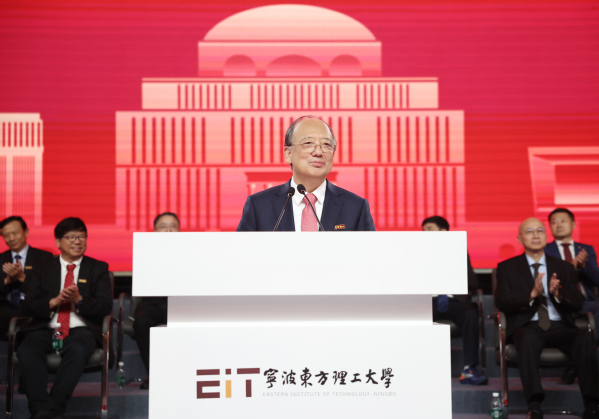
Distinguished Standing Committee Member Yang Yong, Vice Mayor Huang Jiong, Mr. Yu Renrong and Mr. Chen Nanxiang,
Members of the Board, honored guests and colleagues,
Dear students,
Good evening!
Today, we gather beside the Yongjiang River to welcome our incoming class of 2026 to EIT. Bringing together talented young people and preparing them for their times is a university's highest honor. To our 130 new undergraduates and more than 200 new doctoral students: thank you, and
welcome!
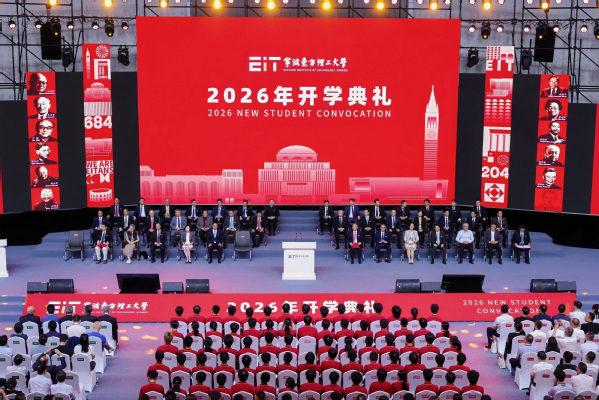
Tonight is both an opening ceremony and a family gathering. Here with us are your parents and high school teachers, guests from this afternoon's Presidents and Principals Forum, representatives of companies supporting our undergraduate summer placements, Board members, and our faculty, staff and students. You are all members of the EIT family. Welcome to our most important annual gathering!
We have entered the AI era. Artificial intelligence is changing every aspect of life, production and society. For centuries, people had to enter a university to reach the frontiers of human knowledge. Today, university courses are available online, students and professors use the same intelligent tools, and anyone can learn university-level material with AI anytime, anywhere. When AI can retrieve vast amounts of knowledge instantly and technology has broken down the walls around it, what is a university's core value? What should we teach? What should students learn? How should we educate? These are major questions for education today.
In the AI era, new universities and long-established institutions stand at the same starting line. DeepSeek changed the global AI landscape overnight. A new university created for its times can stand at the forefront of global higher education. By embracing AI and daring to lead, EIT aims to become an innovative, influential university and a pioneer of educational change.
The more powerful AI becomes, the more important the people who guide it are. As an ancient saying reminds us, achievement depends on talent, and endeavors grow through talent. How far a university can go depends on the people it brings together. A week ago, we spent five days reviewing our first five years and planning the next chapter of educational excellence. Professor K. Jimmy Hsia, Senior Advisor to the President, joined that meeting. He became a full-time member of EIT on August 1. An internationally recognized scholar with extensive experience in university leadership, he has served as Associate Vice Chancellor at the University of Illinois Urbana-Champaign, Vice Provost at Carnegie Mellon University and Vice President at Nanyang Technological University. Over the past year, internationally distinguished scholars including Jie Liang, Zuotai Zhang, Wei Wang, Wei Hong and Yifan Zhao, alongside a group of young scholars, have joined EIT. A few days ago, the National Natural Science Foundation of China announced that our young principal investigator Changhong Wang had been selected for its Young Scientists Fund, Category B. Academicians and nationally recognized talent now account for 61% of our faculty, providing a strong foundation for a world-class new research university.
Ningbo values the unity of knowledge and action, and EIT puts that principle into practice as we explore education for the AI era. In Professor Chen Zhu's “AI for Chemistry” course, students use AI to investigate, question and analyze. At EIT, teaching takes the highest priority. Small-group seminars, academic mentoring, residential colleges, personalized education and research throughout undergraduate study develop independent and original thinking that AI cannot replace. Industry collaboration is a distinctive strength. Our summer Co-op model brings students into companies as educational partners. This June, our inaugural undergraduate cohort undertook placements at 33 companies, including Geely Auto and Bull Group, building their abilities in intelligent manufacturing and AI-enabled industrial settings.
The more advanced AI becomes, the more we need a strong grounding in the humanities. A leading institute of technology needs leading humanities education. Our Distinguished Lecture Series has welcomed Richard Chang to discuss China's semiconductor development, Professor Yi Rao to speak on serving the country through science, and Professor Hua Sun of Peking University to introduce Sanxingdui archaeology and Chinese civilization. This year, the Ministry of Education approved our participation in the high-level Trinity comprehensive admissions scheme, alongside Zhejiang University, Fudan University, Shanghai Jiao Tong University, the University of Chinese Academy of Sciences and Westlake University. Through diverse admissions routes, we seek young people with innovative potential and the courage to take on challenges.
AI for Science has become an important new research paradigm. Competition in AI is systemic, involving chips, computing power, energy and manufacturing. EIT is developing four research platforms in artificial intelligence, integrated circuits, robotics and intelligent manufacturing to advance coordinated research. At the same time, we support investigator-led exploration and a U-shaped evaluation system recognizing both academic and technological contributions. Professor Su-Huai Wei studies optical phonon softening and asks whether electronic devices can shrink by another order of magnitude. Academician Xueliang Sun's team continues to make breakthroughs in solid-state batteries, seeking a leading role for China in next-generation battery technology. Professor Yuntian Chen's team has developed an automotive AI agent that reduces exterior design time from more than ten hours to seconds, improving both efficiency and performance in advanced manufacturing.
Earlier this year, Mr. Yu Renrong met university leaders and faculty representatives. He observed that in a rapidly changing era, we must choose the most advanced fields, recruit the best talent and build disciplines that are either the best in the world or unique in the world. Students, this young university offers you a rare opportunity: to help build a university while studying in it and take part in a major process of innovation and change. Let me offer three hopes for you today.
First, build strong foundations and learn together. The Book of Rites says that studying alone without friends leaves one isolated and poorly informed. Two thousand years later, those words have a new meaning: AI is now among our learning partners. Some worry that extensive AI use may weaken students' thinking and foster dependence. At EIT, we seek to integrate human agency with AI as a tool while preserving systematic knowledge and strong foundations. A few months ago, ten of our undergraduates formed the “EI Kick” team for the 2026 China Robot Competition. They tuned their robot during the day, reviewed progress at night, sought faculty advice on tactics and algorithms, and used AI to search literature and write code. From an EIT laboratory to the Capital International Convention Center, they reached the national top six as the only team composed entirely of first-year students. In EIT's open, inclusive and innovative environment, I hope you will think critically, learn independently and collaboratively, turn innovative ideas into entrepreneurial action, and work with like-minded peers and effective AI tools to realize your dreams and change the world.
Second, remain curious and challenge limits. Algorithms can simulate countless options, but the courage to attempt the hardest one still comes from inner curiosity and determination. Rongpeng Cui, a doctoral student jointly trained by EIT and Shanghai Jiao Tong University, studied naval architecture as an undergraduate before moving into research combining robot dynamics algorithms and motion-control training. Recently, at the World Humanoid Robot Games, he operated the Tiangong–Jingfeng robot, which ran 100 meters in 9.34 seconds, faster than Usain Bolt's human record and setting a new frontier for bipedal robots. After submitting his university application, Zhenhai High School student Chenlin Shen wrote on social media: “With a score of 688, and EIT as my only choice, I want to follow my own path and do interesting things!” This is the spirit of China's young people and the courage of EIT students. Follow your heart, embrace the unknown, take on challenges and find your own way through unexplored territory.
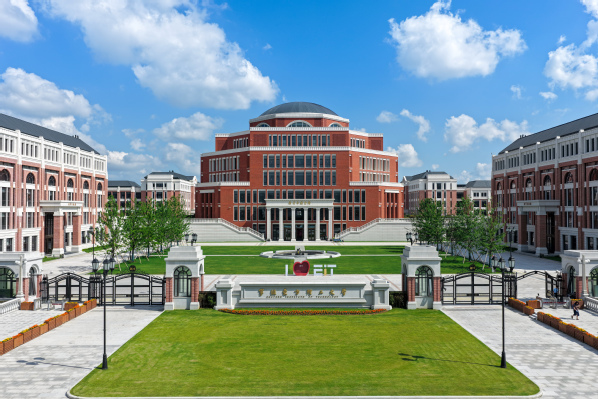
Third, aim high and care about the wider world. The more AI can do, the more precious our uniquely human value becomes. This year, Mr. Wang Jianfeng of Joyson Group donated to name Joyson Building, and Mr. Chen Ruiwu of Hengrun Tongda donated to name Chen Ruiwu Building. AI can calculate a building's construction costs, but it cannot see the entrepreneurs' devotion to their country. After our permanent campus opened, I moved into faculty housing. My favorite part of each day is walking around campus. AI can produce a campus guide, but cannot calculate our love for EIT. AI can translate languages, but cannot replace your international outlook or cross-cultural communication skills. Human creativity, imagination and values are irreplaceable. I hope you will identify important problems, create a better world and guide AI toward good, serving national development and social progress. I also hope you will do something distinctive and meaningful at university that you will remember for the rest of your lives.
Students, in the AI era, anything is possible. Wang Xingxing founded Unitree Robotics at 26. At 31, Kimi founder Yang Zhilin led his team into the global top tier of large-model development. Chen Tianshi founded Cambricon at 31 and made his mark in AI chips. These young people changing the world have shown the possibilities of youth. I believe that among you are future leaders who will change the world and shape your times.
At EIT, the AI revolution meets our commitment to country and society. EIT was born for its times, and you have come for the future. Let us embrace this era, move forward and grow together, and build a world-class new research university!
Thank you.