
On October 31, Eastern Institute of Technology, Ningbo (EIT) held a strategic development seminar for Shenzhou Business School in Shengwei Building. The school was named in November 2025 in recognition of a donation from Jianrong Ma, Executive Chairman of Shenzhou International Group Holdings Limited. It is housed in Shengwei Building, which was named in recognition of a donation from Punan Xu, Chairman of Shengwei International Holdings (China) Co., Ltd.
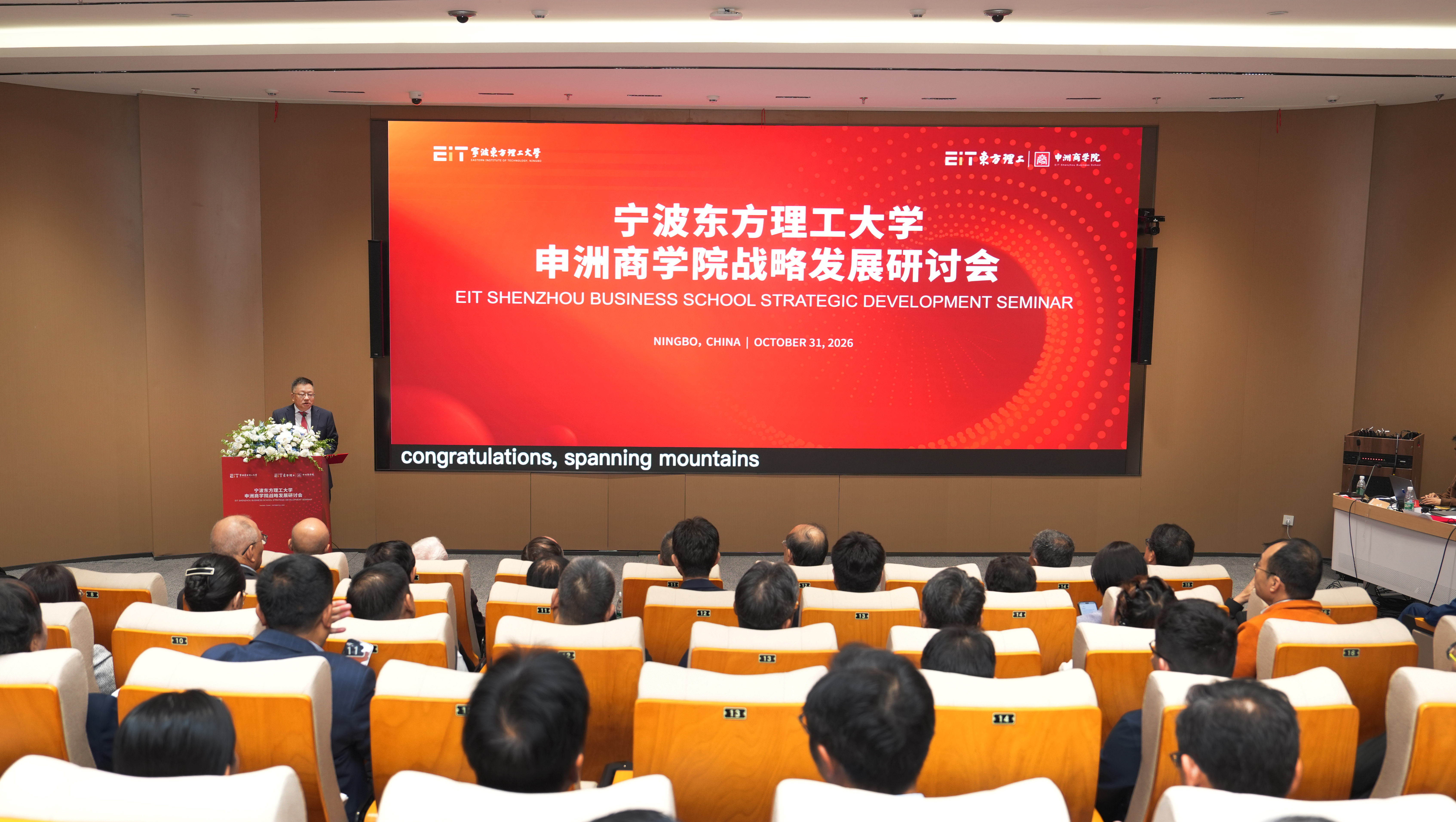
University leaders attending the seminar included President Shiyi Chen, a member of the Chinese Academy of Sciences; Bo Jin, Secretary of the CPC EIT Committee; Vice President and Chair Professor Chunmiao Zheng; and Vice President Wenjun Zeng, an international fellow of the Canadian Academy of Engineering. Executive Vice President and Provost Dongxiao Zhang, a member of the US National Academy of Engineering, chaired the seminar.
Guests included Carlos Álvarez Pereira, Secretary General of the Club of Rome; Fred Dubee, a member of the Club of Rome and a fellow of the World Academy of Art and Science; Anu Rathninde, an executive at a Fortune Global 500 company; and industry leaders from 20 provinces and municipalities across China. Representatives of the Shanghai Women Entrepreneurs Association and the Zhejiang Chamber of Commerce for International Cooperation in the Private Economy also attended to congratulate the school.
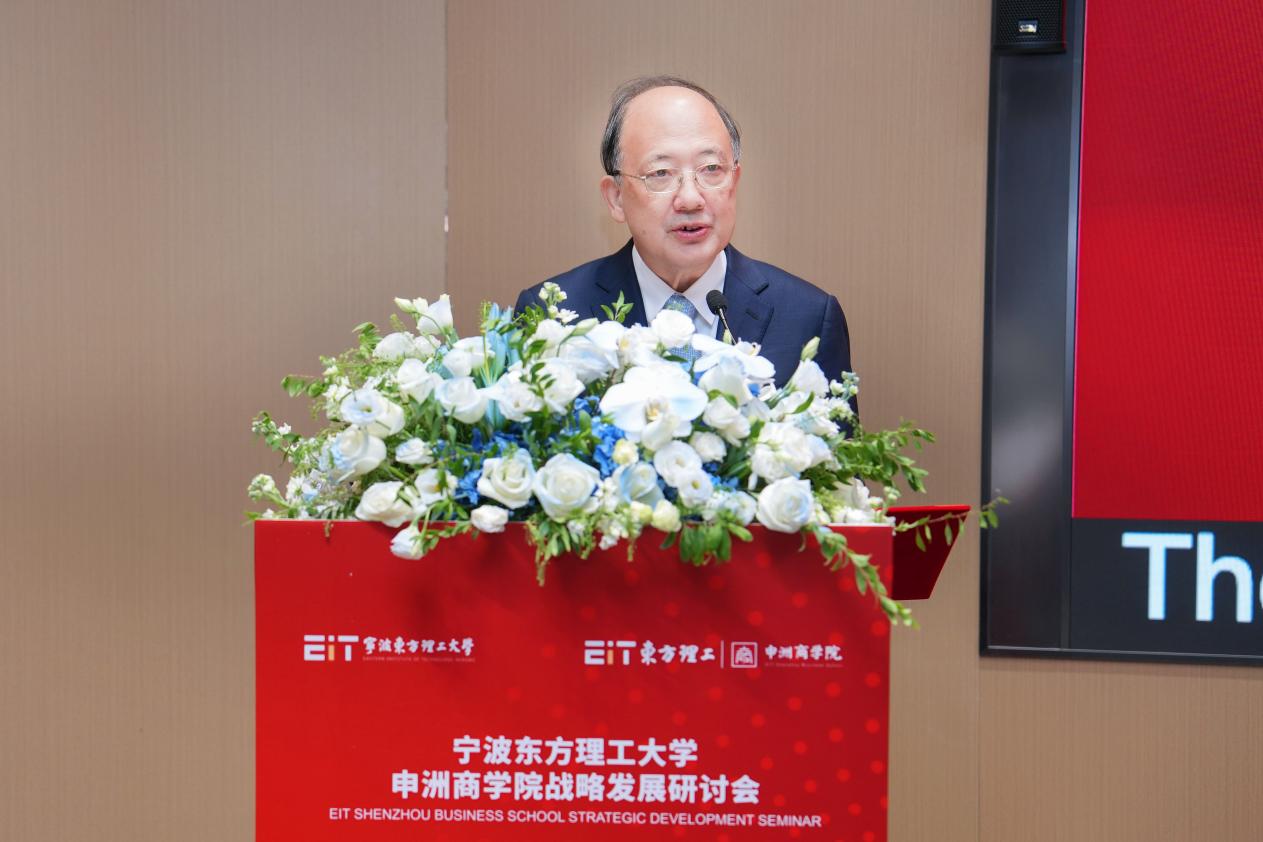
Chen said that leading business schools of the future would go beyond conventional management education by integrating technology, data, and artificial intelligence. He argued that business education should draw on strengths in fields such as AI, advanced materials, and advanced manufacturing, enabling technology to shape industries, data to inform management, and AI to reshape how businesses operate. It should also be international, drawing inspiration from Ningbo entrepreneurs who stayed connected to their country and hometown while building businesses around the world. Chen encouraged faculty and students to think globally, use AI to advance research and practice, and demonstrate the quality of their work on the international academic stage. He added that business education should serve industry by preparing leaders who understand technology, AI, industrial operations, capital markets, and the rules of global business.
Shenglin Ben, Assistant to the President of EIT and Dean of Shenzhou Business School, presented the school’s mission, approach, and development plans. “Shenzhou Business School was born in the AI era. With no legacy structures to hold us back, we have more flexibility and more room to imagine what a business school can be,” Ben said. The school aims to build an AI-native business school that connects scientists with entrepreneurs, brings research universities and industry into closer collaboration, and strengthens ties between China and the rest of the world.
The school aims to develop technology and innovation leaders who understand global markets, science and technology, business operations, and finance. Its graduates should be able to make sense of both the science in the lab and the rules at the negotiating table. To that end, the school is integrating business education with science and engineering, giving researchers and business practitioners a common language. It is also building its faculty along two tracks: recruiting and developing scholars who can compete with peers at leading universities worldwide, and bringing in executives who have led transformation at major companies to teach alongside them. The school also offers specialized programs for private-sector entrepreneurs, bringing practical experience from running businesses into the classroom.
The seminar featured video messages from Han Seung-soo, Honorary Chair of the Council of Presidents of the United Nations General Assembly, President of the 56th session of the General Assembly, and former Prime Minister of the Republic of Korea; Jingdong Hua, Senior Advisor to the Chair of the International Sustainability Standards Board and former Vice President and Treasurer of the World Bank; Geoffrey Garrett, Special Advisor to the President of the University of Southern California for Global Strategy and External Affairs and former Dean of the Wharton School; and Gishan Dissanaike, Dean of Cambridge Judge Business School. They encouraged the school to stay rooted in China, engage with the world, and prepare for the future.
The discussion focused on four topics: the school’s mission, academic development, talent development, and partnerships with industry and the wider community. Participants included EIT Party Secretary Bo Jin; Vice Presidents Chunmiao Zheng and Wenjun Zeng; Yong Yu, Distinguished Professor of Practice at Shenzhou Business School; Min Jiang, Vice President of the All China Lawyers Association; Hai Huang, President of Jilin Heart Hospital; Wei He, Senior Partner at King & Wood Mallesons; Li Huang, Founding Partner of Cowin Capital; Chunhua Huang, Vice President of the Shanghai Women Entrepreneurs Association; Tianni Chen, a board member of the association and Secretary General of its International Exchange Committee; Carlos Álvarez Pereira; and Anu Rathninde. They offered recommendations on building an AI-native, technology-focused business school, integrating business with science and engineering, preparing students to work across disciplines, and bringing together government, industry, universities, research institutions, and investors.
Shenzhou Business School is central to EIT’s efforts to bring business, science, and engineering closer together in support of national priorities and regional economic and social development. The school will build its global, AI-native model by strengthening international partnerships, supporting interdisciplinary work, developing technology entrepreneurs, connecting universities with industry and investors, and applying AI to emerging challenges. Drawing on Ningbo’s vibrant private sector, the school will bring entrepreneurs’ practical experience into conversation with academic research, help scientists and business leaders work together, and support more Chinese companies and brands as they expand internationally.