
On September 20, Xiankang Dou, a member of the Party Leadership Group of the Ministry of Science and Technology, Secretary of the Party Leadership Group and President of the National Natural Science Foundation of China (NSFC), and a member of the Chinese Academy of Sciences, led a delegation to Eastern Institute of Technology, Ningbo (EIT). The delegation toured the university’s research facilities and learned about its approach to education and research. EIT President Shiyi Chen, a member of the Chinese Academy of Sciences, welcomed the delegation and thanked its members on behalf of the university.
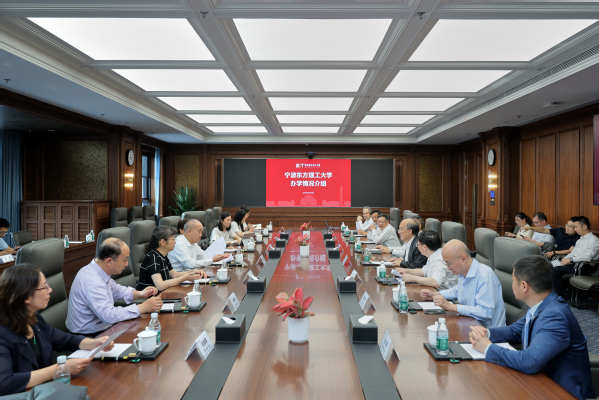
The delegation included Yujie Lan, a member of the NSFC Party Leadership Group and Vice President of the foundation, along with officials from relevant departments. Weifeng Jiang, a member of the Standing Committee of the CPC Ningbo Municipal Committee and head of its Organization Department, and Xiaochen Fei, Director and Secretary of the Party Leadership Group of the Ningbo Municipal Bureau of Science and Technology, accompanied the delegation.
EIT representatives who joined the tour and discussion included Executive Vice President and Provost Dongxiao Zhang, a member of the US National Academy of Engineering; Vice President Wenjun Zeng, an international fellow of the Canadian Academy of Engineering; Xueliang Sun, a foreign member of the Chinese Academy of Engineering and a fellow of both the Royal Society of Canada and the Canadian Academy of Engineering; and Dayong Jin, a fellow of the Australian Academy of Technological Sciences and Engineering.
Drawing on the NSFC’s experience with reform, Dou shared his views on basic research and the development of early-career scientists. He noted that China is moving rapidly from catching up with and keeping pace with global peers to taking the lead in science and technology. To sustain that progress, he said, China must consistently produce original discoveries that advance science and technology worldwide. The NSFC will support both curiosity-driven and goal-oriented research, place greater emphasis on original innovation, and provide outstanding early-career researchers with stable, long-term support. It will also work to end evaluation practices that reward short-term results and quick gains. Citing detailed data, Dou highlighted the size and composition of China’s early-career scientific workforce. He described these researchers as vital to building China’s strength in science and technology and said the NSFC would give them the support they need to focus on their work.
Dou said that new research universities have an important role in developing new ways to nurture outstanding innovators and support basic research. He encouraged EIT to make full use of the flexibility of its institutional model and its international recruitment channels to attract more promising early-career researchers. He also urged the university to venture into uncharted areas of science and pursue landmark advances in basic research, contributing to China’s capacity for independent innovation in science and technology.
Chen said Dou’s remarks offered valuable guidance for the university’s development. As a new research university, EIT is committed to building on a strong foundation, pursuing excellence at a focused scale, and making innovation and international engagement central to its work. It focuses on areas of pressing national need, including artificial intelligence, integrated circuits, life sciences and health, new energy, and advanced materials. Chen said EIT would implement national reforms in basic research and early-career talent development, foster an open academic environment, and give faculty and students the freedom to pursue long-term research. The university will explore new approaches to original and interdisciplinary research and to developing exceptional young talent, with the aim of producing discoveries that lead their fields internationally.
Zhang presented an overview of EIT’s mission, faculty, and research. He noted that the university has assembled an international research team, with several scholars ranked among the world’s top 2 percent of scientists, and has produced notable results in original and interdisciplinary basic research. Drawing on the university’s experience, he also outlined its work and plans for developing early-career researchers, supporting exploratory and interdisciplinary research, and building advanced research facilities.
The delegation toured EIT’s library and key research facilities. It learned about the development of the university’s library and its collaboration with industry leaders on all-solid-state batteries in support of China’s new energy strategy. The delegation also heard about the university’s AI for Science work at the intersection of artificial intelligence and automated chemistry, as well as its research on nanoscale technologies for organelle-targeted precision diagnosis and treatment and efforts to translate those technologies into practical applications.